
Il culto di santa Eurosia affonda le sue radici nella tradizione orale di un piccolo paese di montagna sul versante spagnolo dei Pirenei: Yebra de Basa.
Read in English
The cult of Saint Eurosia has its roots in the oral tradition of a small mountain village on the Spanish side of the Pyrenees: Yebra de Basa.
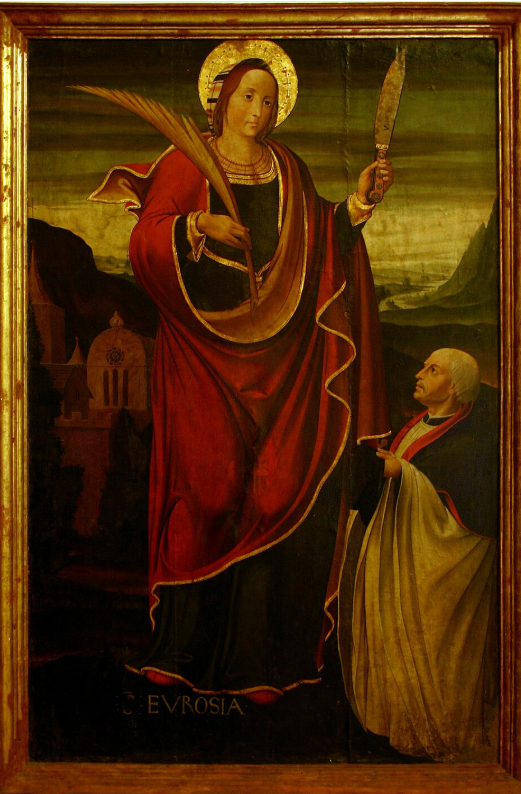
Qui, nella chiesa parrocchiale, è custodita la reliquia della testa della martire, venerata come Patrona della montagna. Il corpo decapitato della santa è custodito in un’urna sotto l’altar maggiore della cattedrale di Jaca, antica capitale del Regno d’Aragona, poco distante da Yebra. I documenti medievali relativi alla storia di Santa Eurosia sono andati perduti: secondo le ricostruzioni più attendibili, degli anni ’50 del secolo scorso, Eurosia sarebbe stata una giovane donna nata nell’864, che scelse di condurre una vita eremitica sul monte di Yebra, dopo aver rifiutato un matrimonio combinato. Qui sarebbe stata uccisa a seguito di uno dei numerosi episodi di guerra nella regione di confine tra la Penisola iberica sotto il dominio arabo e il regno dei Franchi.
Read in English
Here, in the parish church, the relic of the martyr’s head is preserved and venerated as Patron Saint of the mountains. The decapitated body of the saint is kept in an urn beneath the high altar of the cathedral of Jaca, the ancient capital of the Kingdom of Aragon, not far from Yebra. Medieval documents relating to the history of Saint Eurosia have been lost: according to the most reliable reconstructions, dating from the 1950s, Eurosia was a young woman born in 864 who chose to lead an eremitic life on Mount Yebra after refusing an arranged marriage. There she was killed as a result of one of the many episodes of warfare in the border region between the Iberian Peninsula under Arab rule and the Kingdom of the Franks.

Stralcio della mappa del Catasto Sabaudo, 1783
Read in English
Extract from the Savoyard Cadastre map (1783)
Il culto di santa Eurosia fu approvato ufficialmente da papa Leone XIII nel 1902, ma era già diffuso a livello popolare in tutta la Spagna a partire dal XV secolo e, grazie ai soldati spagnoli, anche nell’Italia settentrionale, soprattutto in Piemonte e Lombardia, dove l’intercessione della santa contro le tempeste, i fulmini e le grandinate e per la protezione dei raccolti fu ritenuta in molte occasioni efficace1.
Read in English
The cult of Saint Eurosia was officially approved by Pope Leo XIII in 1902, but it had already been widespread at a popular level throughout Spain from the fifteenth century and, thanks to Spanish soldiers, also in northern Italy, especially in Piedmont and Lombardy, where the saint’s intercession against storms, lightning, and hail, and for the protection of crops, was considered on many occasions to be effective.

Read in English
General view of the Savoyard Cadastre map, 1783, showing the location of the small church in relation to the settlement of Bollengo
In questo contesto si colloca la venuta degli spagnoli presso la città di Ivrea, allo scopo di difenderla dall’assedio del 1641(durante la guerra civile piemontese) e la loro narrazione dei prodigi della martire ai locali, i quali fecero propria la devozione e la confidenza nei confronti della medesima.
Read in English
Within this context falls the arrival of the Spaniards near the city of Ivrea, with the aim of defending it from the siege of 1641 (during the Piedmontese Civil War), and their narration of the martyr’s miracles to the local population, who adopted the devotion and confidence placed in her.
In particolare, i due eporediesi Francesco Ludovico Alberga e Giovanni Domenico Bottiglione, terminata la guerra, verso l’anno 1658 edificarono nei confini delle loro vigne in regione Piane di Bollengo, la chiesa di Santa Eurosia, in stile barocco. La festa in onore di Santa Eurosia ricorreva il 26 giugno e, dietro richiesta dei proprietari, la popolazione si recava in processione alla cappella per assistere alla celebrazione della messa.
Read in English
In particular, the two men from Ivrea, Francesco Ludovico Alberga and Giovanni Domenico Bottiglione, once the war had ended, around the year 1658, built the church of Saint Eurosia in the Baroque style on the boundaries of their vineyards in the area known as Piane di Bollengo. The feast in honor of Saint Eurosia fell on 26 June and, at the request of the owners, the population would go in procession to the chapel to attend the celebration of Mass.
 OROSIA